
Standard containers for sale
Our standard containers are ISO-certified, weather-resistant steel units available in 20ft and 40ft sizes. Built for storage, shipping, and modification, they deliver unmatched durability and value across every state in the US. Browse our inventory and request a free quote today.
You’ve probably driven past a job site and noticed those unmistakable steel boxes stacked like industrial building blocks. Clean lines. Corrugated walls. Lock-worthy doors. What you’re looking at is one of the most reliable structures ever built, and right now, more businesses, homeowners, and contractors across the United States are buying them for uses that go well beyond ocean freight.
Whether you need on-site storage, a modular workspace, or the foundation of a custom build project, standard containers for sale offer a cost-to-value ratio that very few alternatives can match. At ContainerPlus, we supply a range of ISO-certified units built to perform from day one.
What is a standard shipping container?
A standard shipping container is a reusable, steel-framed storage and transport unit manufactured to International Organization for Standardization (ISO) specifications, available in 20ft and 40ft lengths with an 8ft 6in height.
According to ISO standard 668, these containers are designed for seamless intermodal transport across ships, rail, and road without unloading cargo at each stage. Think of them as universal building blocks for global trade and, increasingly, for commercial and residential builds.
The defining features of a standard dry container include:
- Corrugated Corten steel walls for strength and corrosion resistance
- Double swing doors at one or both ends, opening up to 270 degrees
- Marine-grade plywood flooring capable of handling heavy loads
- Built-in forklift pockets for easy repositioning
- Corner castings that meet ISO 1161 for safe stacking
- Small ventilation ports to reduce moisture buildup during storage
“Shipping containers are built to specifications set by the International Organization for Standardization (ISO). Much like LEGO bricks, they’re designed to be universally compatible, allowing for consistent, repeatable use anywhere in the world.” — Boxhub Container Dimensions Guide
"10ft Shipping Containers"
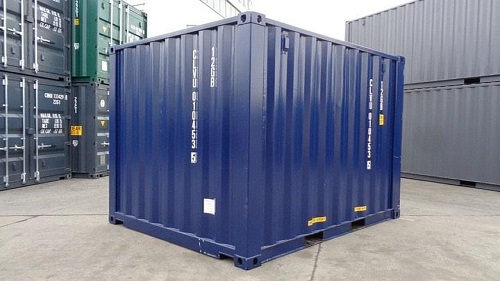
Dimensions
| Length | Width | Height | Weight |
|---|---|---|---|
| 10ft (2991mm) | 8ft (2438mm) | 8ft 6ins (2591mm) | 1250kg |
Internal Dimensions
| Length | 9ft 4ins (2841mm) |
|---|---|
| Width | 7ft 9ins (2352mm) |
| Standard Height | 7ft 10ins (2393mm) |
| End Door Aperture Width | As req. |
| Standard End Door Aperture Height | As req. |
| Floor Area | 72sq ft (6.69m2) |
| Standard Cubic Capacity | 560cu ft (18.89m3) |
| Weight | 1.5t (1.52t) |
"Maximize Space and Security: Discover the 20ft Standard Shipping and Storage Container"
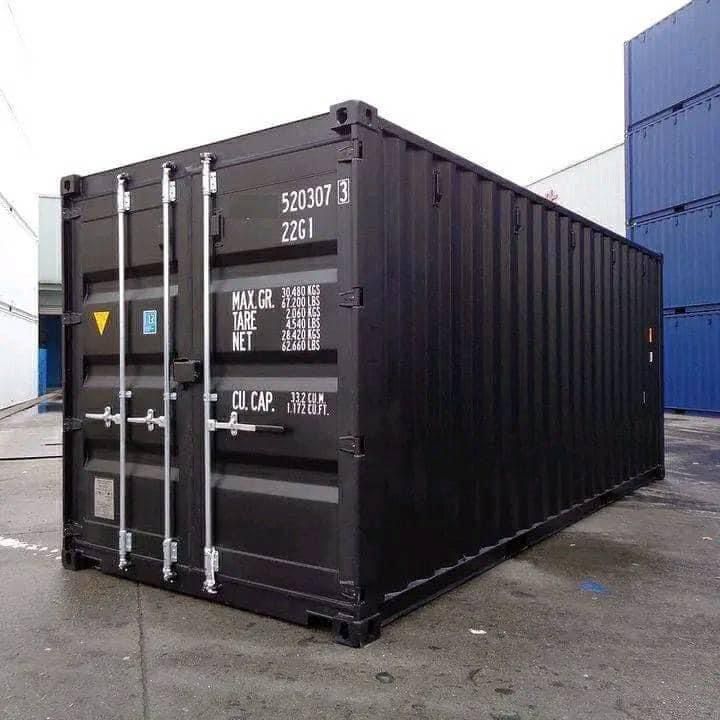
Dimensions
| External size | Internal size | |
|---|---|---|
| Length | 6036 mm | 5898 mm |
| Width | 2438 mm | 2362 mm |
| Height | 2591 mm | 2393 mm |
| Tare | Max. payload | Max. gross |
| 1970 kg | 28510 kg | 30480 kg |
"40ft Standard Shipping and Storage Container: The Ultimate Solution for Your Cargo and Storage Needsr"
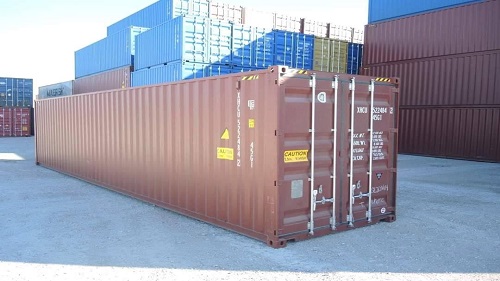
Dimensions
| External size | Internal size | |
|---|---|---|
| Length | 12192 mm | 12032 mm |
| Width | 2438 mm | 2352 mm |
| Height | 2591 mm | 2393 mm |
| Tare | Max. payload | Max. gross |
| 3720 kg | 26760 kg | 30480 kg |
"45ft Shipping Containersr"
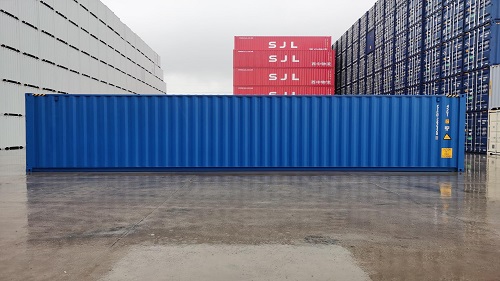
Dimensions
External Dimensions
| Length | Width | Height | Weight | |
|---|---|---|---|---|
| 45ft High Cube | 45ft (13710mm) | 8ft 2ins (2500mm) | 9ft 6ins (2890mm) | 4500kg |
Internal Dimensions
| Length | Width | Height | |
|---|---|---|---|
| 45ft High Cube | 44ft 5ins (13556mm) | 8ft (2430mm) | 8ft 10ins (2692mm) |
Standard container sizes and dimensions: a full comparison
Understanding the numbers before you buy saves time and avoids costly delivery surprises. Here is a detailed breakdown of the two most common sizes we carry at ContainerPlus.
| Specification | 20ft Standard Container | 40ft Standard Container |
|---|---|---|
| External length | 6.06m (19ft 10in) | 12.19m (40ft 0in) |
| External width | 2.44m (8ft 0in) | 2.44m (8ft 0in) |
| External height | 2.59m (8ft 6in) | 2.59m (8ft 6in) |
| Internal length | 5.90m (19ft 4in) | 12.03m (39ft 5in) |
| Internal width | 2.35m (7ft 8in) | 2.35m (7ft 8in) |
| Internal height | 2.39m (7ft 10in) | 2.39m (7ft 10in) |
| Internal volume | 33.2 m³ (1,172 cu ft) | 67.7 m³ (2,390 cu ft) |
| Max payload | 28,200 kg (62,170 lbs) | 28,800 kg (63,494 lbs) |
| Tare weight | approx. 2,230 kg | approx. 3,750 kg |
| Common use cases | Storage, offices, small builds | Large storage, commercial, workshops |
Source: GoFreight Container Dimensions Guide
Why buy a standard container instead of renting storage?
Standard containers are more cost-efficient to own long-term than monthly storage rentals, offering a one-time investment with a service life exceeding 25 years.
Here is the case in plain numbers. A standard 10×10 storage unit in most U.S. cities runs between $80 and $200 per month. A used 20ft standard container costs as little as $1,500 to $3,000 outright. At $150 per month in rental fees, you break even in under two years and own a depreciating asset you can resell, repurpose, or modify at any point.
Beyond raw economics, ownership gives you:
- Location control – place it on your property, job site, or farm
- Security – heavy-gauge steel walls resist break-ins far better than most storage units
- Modification freedom – cut windows, add doors, run electrical without landlord restrictions
- No lease terms – scale up or down when your needs change
Best standard container options: 20ft vs 40ft, which one is right for you?
The best container size depends on your space, load volume, and intended use. A 20ft unit suits most storage and single-room workspace builds; a 40ft is better for large-scale storage or multi-person offices.
Choose the 20ft standard container if you:
- Need a compact, accessible storage unit on a residential lot
- Want to convert it into a shipping container office with a smaller footprint
- Are working with a limited budget (lower purchase price and delivery cost)
- Need a unit that fits easily on a standard driveway or small site
Choose the 40ft standard container if you:
- Require high-volume storage for inventory, equipment, or materials
- Are building a larger modular space or connected-container structure
- Run a business that needs a full-scale office container setup
- Want maximum value per square foot of steel
Browse our 40ft standard shipping containers and 20ft shipping containers to compare inventory in your area.
How much do standard containers for sale cost in the United States?
Standard container prices in the U.S. range from $1,500 to $6,500 depending on condition, size, and location. New one-trip units cost more; used wind-and-watertight containers offer the best value for storage.
According to Container xChange’s 2025 market data, current average pricing breaks down as follows:
| Container type | Used (WWT) | New (one-trip) |
|---|---|---|
| 20ft standard | $1,500 to $3,000 | $2,500 to $5,000 |
| 40ft standard | $2,000 to $4,500 | $3,500 to $6,500 |
| 40ft high cube | $2,500 to $5,000 | $4,000 to $7,000 |
Source: Container xChange and Container Management Inc.
A recent price study by YES Containers covering U.S. transaction data from November 2025 through April 2026 found that used containers consistently cost 35 to 50 percent less than new one-trip units of the same size, making condition the single biggest lever for any buyer working to a budget.
Factors that affect your final price:
- Location – coastal depots like Los Angeles, Houston, Miami, and New York carry larger inventories and more competitive pricing
- Condition grade – cargo worthy (CW), wind and watertight (WWT), or as-is
- Delivery distance – on average, delivery within the U.S. costs $2,000 to $5,000
- Modifications requested – windows, doors, electrical, and insulation all add to the base price
Request a personalized quote and our team will confirm pricing and availability at the nearest depot to your location.
Where to buy standard containers for sale in the United States
The best place to buy standard containers in the United States is through a verified supplier with depot access near your location, transparent grading standards, and delivery to all 48 lower states.
At ContainerPlus, we source ISO-certified standard containers directly through a network of vetted depots. We serve customers across every major U.S. market, from coastal hubs to inland cities, and we provide clear condition grading so you know exactly what you are getting before your container arrives.
Coastal depots (best availability): Los Angeles, Houston, Miami, New York, Chicago
Inland depots (good availability): Denver, Kansas City, Las Vegas, Salt Lake City, Louisville
For buyers in landlocked states, delivery logistics become more important. Our team coordinates transport so you do not have to manage the logistics chain yourself.
Explore our full inventory at containerplus.us/standard-containers or check our shipping containers page for additional options.
Top uses for standard containers in the United States
Storage and warehousing
The most common reason businesses and homeowners buy standard shipping containers is straightforward: secure, weatherproof storage. Whether it is construction equipment, seasonal inventory, farming supplies, or personal belongings between moves, a Corten steel container keeps contents protected from the elements and from unauthorized access.
Modular offices and job-site workspaces
A shipping container office built from a standard 20ft unit provides roughly 160 square feet of usable workspace. A 40ft unit doubles that. With insulation, electrical work, windows, and HVAC added, modified containers serve as fully functional job-site offices, field command centers, and even permanent business premises. The U.S. military uses modified containers to deploy barracks and operational centers quickly, which speaks to both the durability and flexibility of the format.
Pop-up retail and hospitality
The container retail trend has moved far past novelty. Breweries, coffee shops, boutique clothing stores, and food vendors across the country have converted standard containers into permanent fixtures. Their structural integrity, visual impact, and relatively low build cost make them a smart platform for independent businesses.
Container homes and ADUs
With the U.S. housing market placing increasing pressure on construction costs, standard containers are now a legitimate structural base for accessory dwelling units (ADUs), guesthouses, and full container homes. Expect to pay between $30,000 and $85,000 for a single-container build and up to $175,000 for multi-container configurations with full finishes.
Disaster relief and emergency response
Their portability and structural resilience make standard containers ideal for emergency deployment. FEMA and nonprofit organizations have used them as temporary medical stations, supply storage, and command posts in disaster-affected areas.
How to order standard containers for sale from ContainerPlus
Ordering is straightforward. Here is our process:
- Browse our inventory at containerplus.us/standard-containers or the quotation form
- Select your size and condition – 20ft or 40ft, new or used, WWT or cargo worthy
- Request a quote – our team confirms availability at the closest depot to your delivery address
- Schedule delivery – we coordinate transport to your site anywhere in the lower 48 states
- Inspect on arrival – all our containers meet stated grade specifications on delivery
We recommend contacting us through our contact page if you have specific modification requirements or need to discuss volume pricing.
Read what our customers say on our reviews page before you commit.
Key takeaways
- Standard containers come in two main sizes – 20ft and 40ft – both built to ISO specifications with an 8ft 6in standard height
- Prices range from $1,500 to $6,500 depending on condition, size, and location in the U.S.
- Used WWT containers cost 35 to 50 percent less than new one-trip units of the same size
- Applications go well beyond shipping – offices, storage, retail, homes, and emergency use are all common
- Coastal depots offer better availability than inland locations; delivery to all 48 lower states is standard
- ContainerPlus offers ISO-certified inventory with transparent grading, competitive pricing, and nationwide delivery
Frequently asked questions about standard containers for sale
What is the standard size of a shipping container?
Standard shipping containers are 20ft or 40ft long, 8ft wide, and 8ft 6in tall. The 20ft unit holds 33.2 cubic meters of cargo; the 40ft holds 67.7 cubic meters.
The ISO 668 specification governs these dimensions, which is why containers are interchangeable across ships, trains, and trucks worldwide. The width of 8 feet is fixed across virtually all standard ISO units transported by sea.
How much does a standard 20ft container cost in the USA?
A used 20ft standard container costs between $1,500 and $3,000 in the United States; a new one-trip 20ft container costs $2,500 to $5,000 before delivery.
Delivery fees typically add $2,000 to $5,000 depending on distance from the nearest depot. Container xChange’s 2025 pricing data confirms these national averages, though local pricing varies by ZIP code and depot inventory.
What is the difference between a standard container and a high cube container?
A standard container is 8ft 6in tall; a high cube container is 9ft 6in tall. The extra 12 inches of interior height makes high cube units better for tall cargo, walk-in builds, and HVAC installation.
High cube containers typically cost $200 to $500 more than their standard counterparts of the same length and condition. For storage-only use, a standard container is usually sufficient and more cost-effective. For office or residential conversions, many buyers prefer the additional headroom a 20ft high cube provides.
Can a standard container be used as an office or home in the United States?
Yes. Standard containers can be legally modified into offices, studios, and homes across most U.S. states, subject to local zoning and building permit requirements.
With insulation, electrical wiring, HVAC, windows, and interior finishes added, a standard 20ft container becomes a functional 160-square-foot workspace. A 40ft unit provides 320 square feet, comparable to a compact apartment. Local permit requirements vary significantly, so checking with your county or city planning department before beginning any conversion is strongly recommended.
How long do standard shipping containers last?
A well-maintained standard shipping container lasts 25 to 30 years or more. Corten steel construction resists rust, denting, and weather damage far better than timber or composite alternatives.
Used containers retired from active shipping typically have 10 to 15 years of ocean service behind them and can last another 10 to 20 years in static use, according to Pelican Containers’ condition analysis. Applying a fresh coat of container-grade paint every few years significantly extends the service life of any used unit.
Are standard containers wind and watertight?
Yes, containers graded as wind and watertight (WWT) are confirmed to seal against rain and wind and are ideal for dry storage use on land, though they cannot be certified for ocean export.
Cargo worthy (CW) containers meet a higher standard and can be inspected and certified for active sea freight. If your purpose is on-site storage or a modular build rather than international shipping, a WWT-graded standard container for sale offers solid value at a lower price point than a CW unit.
References
- ISO 668: Series 1 freight containers — Classification, dimensions and ratings
- Boxhub: Shipping container dimensions, sizes and measurements guide
- GoFreight: Shipping container dimensions — everything you need to know
- Container xChange: Shipping container price guide 2025
- YES Containers: New vs used container price study (2026)
- Falcon Structures: The ultimate guide to modified shipping containers
- Pelican Containers: How much does a used shipping container cost